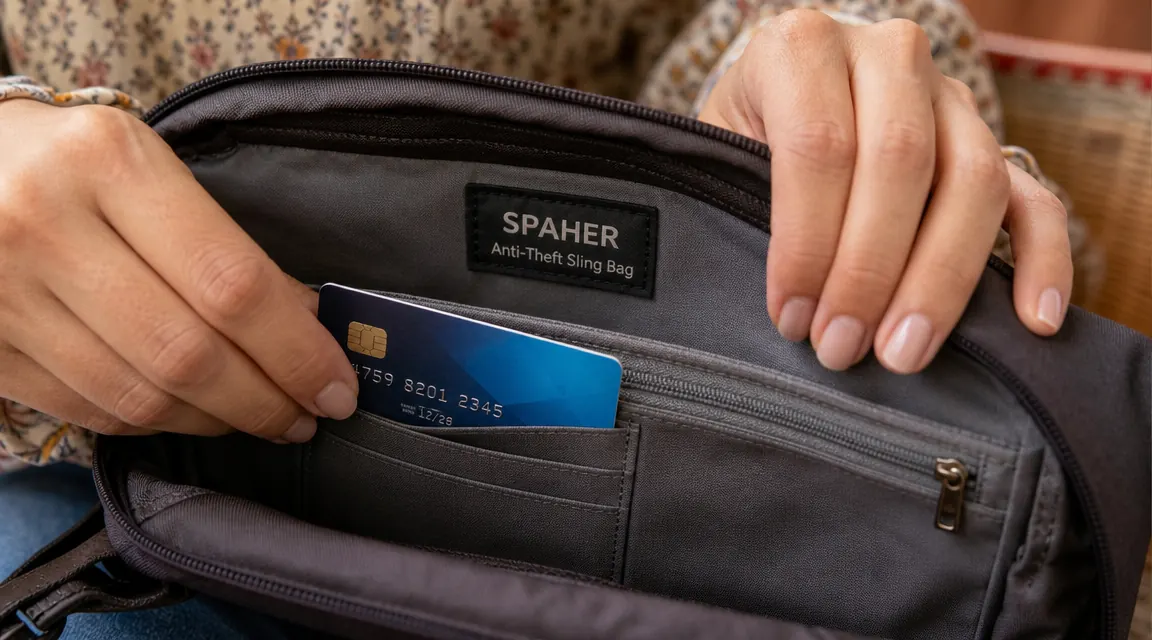
Here is the situation I was in: standing in line at a theme park with my two kids, juggling sunscreen, snacks, and two small humans who were already at capacity for listening. My purse was gaping open. I had no idea who was standing behind me. If someone wanted to skim my credit card or lift my wallet, I basically handed them the opportunity. That trip is what made me finally look into anti-theft bags. And once I started looking, I found two options that kept coming up: the SPAHER Anti-Theft RFID Sling Bag at around $20, and the Pacsafe Vibe 150 crossbody at roughly $80 to $110 depending on where you shop. The question I needed answered was simple: is the Pacsafe worth four to five times the price, or does the SPAHER do the same job without the premium?
Short answer: for the vast majority of family travelers, the SPAHER delivers the features that actually matter at a price that makes sense. The Pacsafe has real advantages, but they are engineering details that matter most to solo international travelers carrying expensive gear, not to a mom managing two kids at Disney. Here is the full breakdown.
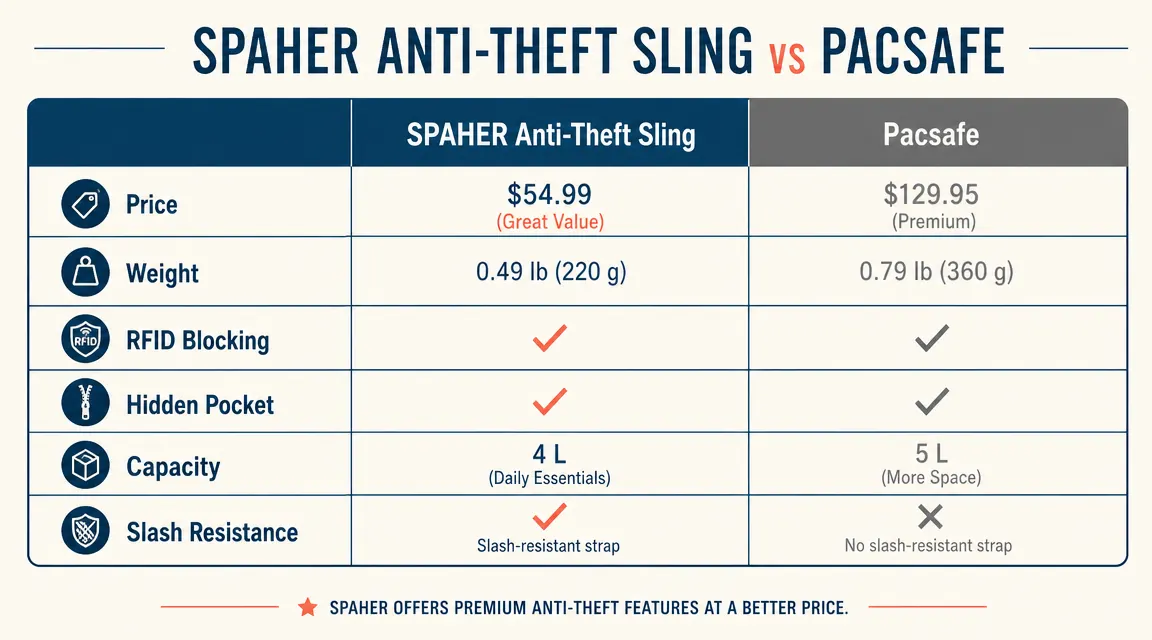
| Anti-Theft Sling Bag | Pacsafe Crossbody | |
|---|---|---|
| Price | Check today's price on Amazon | Mid-range pricing |
| RFID Blocking | Yes (card slots lined) | Yes (full lining) |
| Hidden Zipper Pocket | Yes (back panel, body-side) | Yes (built-in stash pocket) |
| Slash-Resistant Material | No | Yes (Roobar steel wire mesh) |
| Lockable Zippers | No | Yes (eXomesh zipper pulls) |
| Bag Weight | ~0.5 lb empty | ~0.8 lb empty |
| Capacity | ~7L | ~4.5L |
| Adjustable Strap | Yes, crossbody or sling | Yes, crossbody |
| Rating (Amazon) | 4.5 stars / 2,710 reviews | Not sold on Amazon (specialty retailers) |
Where the SPAHER Wins
The price difference is the most obvious win, and it is hard to overstate how much it matters for family travel. When you are buying one bag per adult because you both need your hands free with kids in tow, spending $20 per bag instead of $90 per bag means you can outfit the whole family for the cost of a single Pacsafe. My husband and I both carry our own bags on trips now, and that setup would have cost us over $200 with Pacsafe. With the SPAHER it cost us $40 total.
Capacity is the other area where the SPAHER genuinely outperforms. The Pacsafe Vibe 150 is designed to be slim and discreet, and it is, but that means it only holds about 4.5 liters. With two kids, I need to carry sunscreen, a snack bar, lip balm, a folded rain poncho, my phone, my wallet, two kids' park tickets, and whatever small item my daughter handed me to hold five minutes ago. The SPAHER's roughly 7-liter capacity fits all of that without straining the zipper. The Pacsafe would force me to also carry a separate tote, which defeats the whole point of a crossbody security bag.
Weight is another small but real win for the SPAHER. The RFID lining, steel mesh, and lockable hardware in the Pacsafe add up to a noticeably heavier bag. On a 10-hour park day, that difference matters. The SPAHER sits light across your chest and stays comfortable even when fully loaded. The Pacsafe is not uncomfortable by any means, but the SPAHER has a genuine edge for all-day wear.
Your cards are getting skimmed in crowded places. This $20 bag stops that.
The SPAHER Anti-Theft RFID Sling has a hidden back-panel pocket for your most important cards and a slash-resistant-free design that stays light enough for all-day wear with kids. Over 2,700 verified buyers rated it 4.5 stars.
Amazon Check Today's Price on Amazon →Where Pacsafe Wins
The Pacsafe's engineering is genuinely impressive and worth understanding, even if it is overkill for most family trips. The Roobar steel wire mesh woven into the bag fabric means a would-be thief cannot simply slash the bottom of the bag and grab your contents, a technique actually used by pickpockets in busy European transit hubs. The eXomesh lockable zipper pulls let you clip the zippers to a fixed point so a bump-and-grab move cannot open your bag without you noticing. And the RFID blocking in the Pacsafe is full-lining construction, meaning every compartment has protection, not just the dedicated card slots.
If you are traveling solo to Rome, Barcelona, Prague, or any city that appears regularly on pickpocket warning lists, and if you are carrying a DSLR camera, an expensive passport wallet, and a laptop, the Pacsafe's hard-security features are not overkill. They are exactly right. The bag was designed for that exact scenario, and it delivers. The SPAHER was not designed for that scenario and would not be my recommendation for it.
The Pacsafe wins on engineering. The SPAHER wins on the math of family travel, where you need two bags, all-day comfort, and enough room for a kid's snack and a folded poncho.
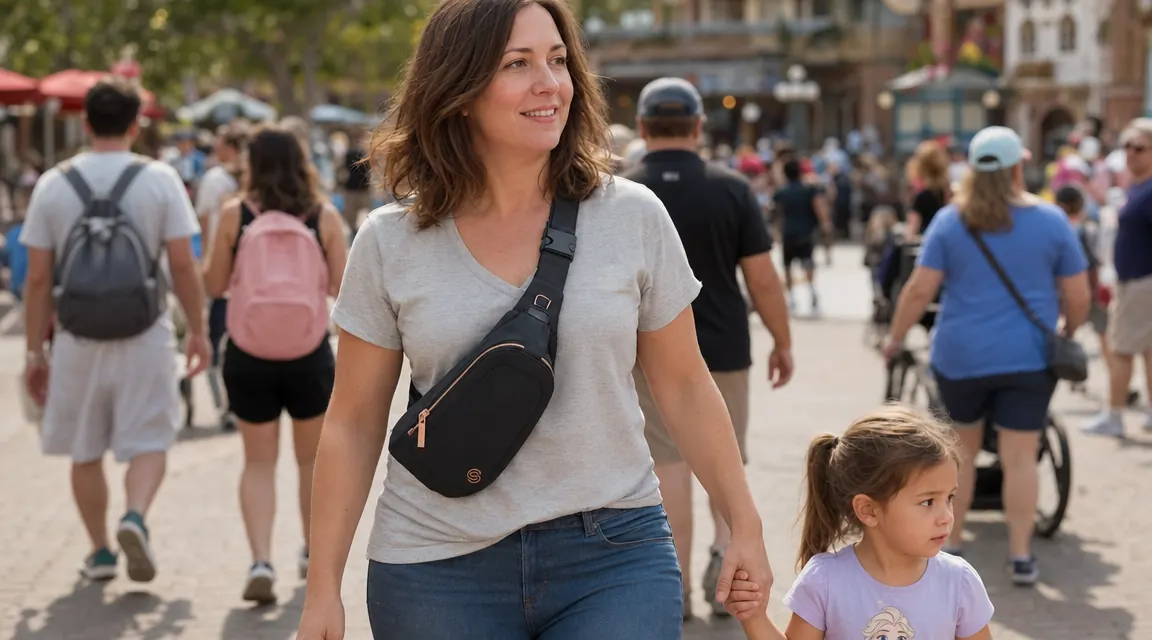
Security Features Side by Side: What Actually Matters for Family Travel
Both bags share the features that handle the most common real-world threats most family travelers actually face. The hidden back-panel pocket on the SPAHER sits against your body when the bag is worn correctly, making it essentially inaccessible to someone reaching in from behind. RFID blocking in the card slots protects your credit cards, debit cards, and passport chip from electronic skimming, the kind of low-effort theft that happens in crowded queues and transit lines. These two features address the threat model that applies at theme parks, airport terminals, busy boardwalks, and street fairs. That is the threat model most of us actually live in.
Slash resistance and lockable zippers address a more aggressive, more organized type of theft that is genuinely uncommon in domestic US travel. Not impossible, but uncommon. At a Florida theme park or a Nashville honky-tonk strip, the realistic threat is distraction theft: someone bumping into you while an accomplice reaches into your bag, or a scanner at close range catching your card details. The SPAHER handles both of those. At a Barcelona metro station at midnight, the threat profile escalates. The Pacsafe handles all of it.
For a practical read on how to use either bag in crowded airport situations, the guide on staying safe at crowded airports with an RFID bag covers positioning, what to keep in which pocket, and how to wear a crossbody so it actually functions as intended.
Build Quality and Everyday Use
The SPAHER is made from water-resistant nylon that wipes clean and holds up well to regular use. The zippers are smooth and the seams are solid. At this price point, the build quality is genuinely better than you expect, which is one reason it has over 2,700 reviews and holds a 4.5-star average. It is not built to last 20 years of hard travel. The stitching at the strap attachment point is a common wear point that shows up in long-term reviews. But for a year or two of regular family-trip use, the construction is completely adequate.
The Pacsafe uses higher-grade materials throughout. The straps are reinforced and the hardware is heavier. If you want a bag that will be in your travel rotation for a decade and handle both beach trips and international business travel without degrading, the Pacsafe is the better investment over the long run. The SPAHER is better described as a replacement-cycle bag: buy it, use it well for a couple of years, replace it if needed. At $20, that calculus works.
Who Should Buy Which
Buy the SPAHER if you are a family traveler doing domestic road trips, flights, theme parks, festivals, or outdoor markets. If you need a second bag for your spouse so you are both hands-free with kids. If you want RFID protection and a hidden pocket without spending close to $100. If you are shopping for a graduation gift, a first travel bag, or a backup for a trip where your main bag is already spoken for. The SPAHER is the right answer for all of that.
Buy the Pacsafe if you are a solo traveler heading to high-pickpocket destinations in Europe, South America, or Southeast Asia. If you are carrying gear that costs more than the bag by a factor of ten. If you travel frequently enough that amortizing an $80-110 cost over 50 trips makes the per-trip cost less than $2. If peace of mind is genuinely worth a premium to you and you want the most comprehensively secure bag on the market. It earns that reputation.
If you are still deciding on the SPAHER and want a closer look at how it performs on its own merits, the full SPAHER Anti-Theft Sling Bag review covers long-term use, pocket layout, and how the RFID blocking actually works in practice.
Honest Cons for the SPAHER
The SPAHER is not without its real drawbacks, and I want to be straight about them. The lack of slash-resistant material is a genuine security gap compared to the Pacsafe. If you travel internationally to cities with organized pickpocket activity, that matters. The RFID protection covers the card slots specifically but not every cubic inch of the bag interior, so if you keep a passport in the main compartment rather than the RFID slot, it is not fully protected. The strap, while adjustable and comfortable, is a single-layer nylon construction without the Pacsafe's reinforced cut-resistant core. Someone determined and equipped could cut through it.
The organizational layout is also simpler than the Pacsafe. There are fewer sub-pockets and no key clip, which means smaller items can migrate around the main compartment. It is a livable limitation but worth knowing if you are very particular about where everything lives inside your bag.
Most family travelers do not need $100 worth of anti-theft engineering. They need this.
The SPAHER Anti-Theft RFID Sling gives you the features that stop everyday theft: a hidden body-side pocket, RFID-blocking card slots, and a crossbody fit that keeps the bag in front where you can see it. At around $20 with a 4.5-star rating from over 2,700 buyers, it is the practical choice for everyday family travel.
Amazon Check Today's Price on Amazon →